

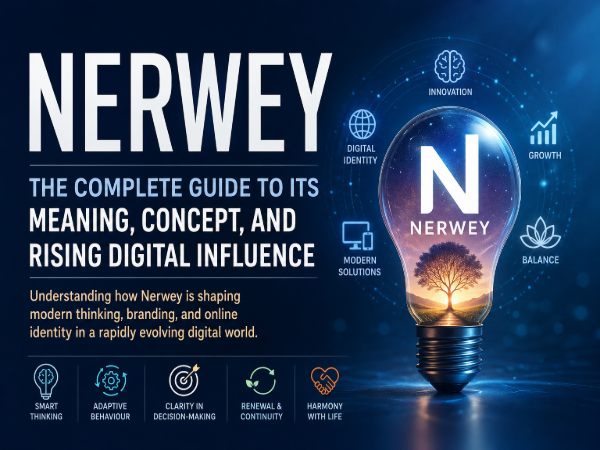
Nerwey is best understood as a conceptual framework that explores the intersection of adaptive technologies, human behavior, and evolving digital ecosystems. It is not a single product, platform, or invention. Instead, it represents a way of thinking about how systems learn, interact, and reshape environments in real time. In the first glance, Nerwey appears abstract, but its implications are practical and increasingly visible in everyday life.
At its core, Nerwey addresses a central question: how do systems technological, social, and cognitive adapt continuously in a world defined by rapid change? The answer lies in integration. Nerwey proposes that intelligence is no longer isolated within machines or humans. It emerges from the interaction between them.
This framework is especially relevant in an era dominated by artificial intelligence, decentralized networks, and behavioral data. From personalized digital experiences to smart urban infrastructure, Nerwey offers a lens to interpret these shifts. It is both descriptive and predictive, explaining current transformations while hinting at future possibilities.
As industries and societies grapple with complexity, Nerwey provides a structured yet flexible approach. It bridges disciplines, connecting technology with sociology, economics, and design. The result is a holistic understanding of how systems evolve not in isolation, but through continuous interaction.
The Origins and Conceptual Foundations of Nerwey
The idea of Nerwey emerges from interdisciplinary thought. It draws from systems theory, cybernetics, and modern artificial intelligence research. These fields share a common belief: systems are dynamic, not static.
Historically, the roots of such thinking can be traced back to mid-20th-century research in feedback loops and control systems. Scholars began to understand that systems could regulate themselves through continuous input and output cycles. Nerwey expands on this idea by incorporating human behavior as a core component.
In practical terms, Nerwey suggests that systems evolve through three forces:
- Continuous data exchange
- Adaptive learning mechanisms
- Environmental feedback
This triad forms the backbone of the framework. Unlike traditional models, which treat systems as predictable, Nerwey embraces uncertainty. It acknowledges that change is constant and often nonlinear.
Experts in digital transformation often emphasize the importance of adaptability. As one technology strategist noted, “The systems that survive are not the strongest, but the most responsive to change.” This principle aligns closely with Nerwey’s philosophy.
Key Components That Define Nerwey
Understanding Nerwey requires breaking it down into its core components. Each element contributes to the system’s overall adaptability and intelligence.
| Component | Description | Role in Nerwey |
|---|---|---|
| Data Flow | Continuous exchange of information across systems | Enables real-time responsiveness |
| Adaptive Algorithms | Systems that learn and evolve based on inputs | Drives intelligent behavior |
| Human Interaction | User behavior and decision-making patterns | Shapes system evolution |
| Feedback Loops | Mechanisms that refine outputs based on outcomes | Ensures continuous improvement |
| Environmental Input | External factors such as market trends or social changes | Keeps systems context-aware |
Each of these components interacts dynamically. For example, human interaction generates data, which feeds into adaptive algorithms. These algorithms then adjust outputs, influencing future behavior.
This interconnectedness is what makes Nerwey distinct. It is not about isolated innovation but about integrated evolution.
Nerwey in Modern Technology Ecosystems
The principles of Nerwey are already visible in contemporary technology. From recommendation systems to autonomous vehicles, many innovations reflect its core ideas.
Consider digital platforms that personalize content. These systems analyze user behavior, adapt in real time, and refine their outputs continuously. This is a direct application of Nerwey’s feedback-driven model.
Similarly, smart cities rely on interconnected systems that respond to environmental and human inputs. Traffic management, energy distribution, and public services are increasingly governed by adaptive algorithms.
A data scientist once observed, “We are moving from programmed systems to learning systems.” This shift is central to Nerwey. It marks a transition from static design to dynamic interaction.
The implications are profound. Technology is no longer just a tool; it becomes a participant in human environments. It learns, adapts, and evolves alongside users.
Societal Impacts of the Nerwey Framework
Nerwey is not limited to technology. Its influence extends into social and cultural domains. As systems become more adaptive, they begin to shape human behavior in subtle ways.
For instance, personalized digital environments can influence decision-making. From shopping habits to media consumption, adaptive systems guide user choices. This raises important questions about autonomy and control.
At the same time, Nerwey offers opportunities for positive change. Adaptive systems can improve accessibility, enhance education, and optimize resource allocation. The key lies in responsible implementation.
| Impact Area | Positive Outcomes | Potential Risks |
|---|---|---|
| Education | Personalized learning experiences | Over-reliance on automated systems |
| Healthcare | Predictive diagnostics and tailored treatments | Data privacy concerns |
| Economy | Efficient resource distribution | Job displacement due to automation |
| Social Behavior | Enhanced connectivity and communication | Echo chambers and behavioral manipulation |
| Governance | Data-driven policy decisions | Ethical challenges in surveillance |
Balancing these outcomes is crucial. Nerwey does not inherently favor positive or negative results. It depends on how systems are designed and governed.
The Role of Human Agency in Nerwey
One of the most critical aspects of Nerwey is the role of human agency. While systems become increasingly intelligent, humans remain central to their operation and direction.
Human decisions shape the data that systems learn from. They define the objectives that algorithms pursue. In this sense, Nerwey is a collaborative framework rather than a purely technological one.
A behavioral economist once stated, “Technology reflects the values of its creators.” This insight is particularly relevant here. Nerwey systems are not neutral; they embody the assumptions and priorities of those who design them.
This underscores the importance of ethical considerations. Transparency, accountability, and inclusivity must be integral to system design. Without these principles, adaptive systems risk reinforcing biases and inequalities.
Expert Perspectives on Nerwey
Scholars and industry leaders have begun to explore concepts aligned with Nerwey, even if they use different terminology. Their insights provide valuable context.
One AI researcher noted, “The future of intelligence lies in collaboration between human intuition and machine precision.” This aligns with Nerwey’s emphasis on integration.
Another expert in urban development observed, “Cities are becoming living systems, constantly adapting to their inhabitants.” This reflects the application of Nerwey in physical environments.
A third perspective from a digital ethicist highlights caution: “Adaptive systems must be designed with safeguards, or they risk amplifying existing societal issues.”
These viewpoints illustrate the complexity of Nerwey. It is not a single solution but a framework that requires careful consideration and ongoing refinement.
Takeaways
- Nerwey is a conceptual framework combining technology, human behavior, and adaptive systems.
- It emphasizes continuous learning through data, feedback, and environmental input.
- Modern technologies like AI and smart systems already reflect Nerwey principles.
- The framework has significant societal implications, both positive and negative.
- Human agency remains central to guiding system behavior and outcomes.
- Ethical design is essential to ensure responsible implementation.
Conclusion
Nerwey represents a shift in how we understand systems in a rapidly evolving world. It moves beyond static models, embracing adaptability, interaction, and continuous learning. In doing so, it offers a powerful lens for interpreting technological and societal change.
The framework’s strength lies in its flexibility. It can be applied across industries, from digital platforms to urban planning. Yet, this versatility also demands responsibility. As systems become more integrated into daily life, the choices made by designers, policymakers, and users become increasingly important.
Ultimately, Nerwey is not just about technology. It is about relationships between systems, environments, and people. It challenges us to think differently about intelligence, control, and evolution.
As the world continues to change, frameworks like Nerwey will play a crucial role in shaping the future. The question is not whether systems will adapt, but how we choose to guide that adaptation.
FAQs
What is Nerwey in simple terms?
Nerwey is a conceptual framework that explains how systems adapt and evolve through interaction, data, and feedback in dynamic environments.
Is Nerwey a technology or a theory?
It is primarily a conceptual theory, but its principles are applied in modern technologies like AI and smart systems.
Where is Nerwey used today?
Its ideas are reflected in personalized digital platforms, smart cities, and adaptive algorithms used across industries.
What are the risks of Nerwey-based systems?
Potential risks include data privacy issues, algorithmic bias, and over-reliance on automated decision-making.
Why is Nerwey important for the future?
It helps explain and guide how systems will evolve in increasingly complex and interconnected environments.
APA References
Wiener, N. (1948). Cybernetics: Or control and communication in the animal and the machine. MIT Press. https://mitpress.mit.edu
Russell, S., & Norvig, P. (2021). Artificial intelligence: A modern approach (4th ed.). Pearson. https://aima.cs.berkeley.edu
OECD. (2021). Artificial intelligence in society. https://www.oecd.org/digital/artificial-intelligence/
World Economic Forum. (2023). The future of jobs report. https://www.weforum.org/reports/the-future-of-jobs-report-2023/
UNESCO. (2022). Recommendation on the ethics of artificial intelligence. https://www.unesco.org/en/artificial-intelligence/recommendation-ethics
MIT Technology Review. (2023). The state of AI and adaptive systems. https://www.technologyreview.com