

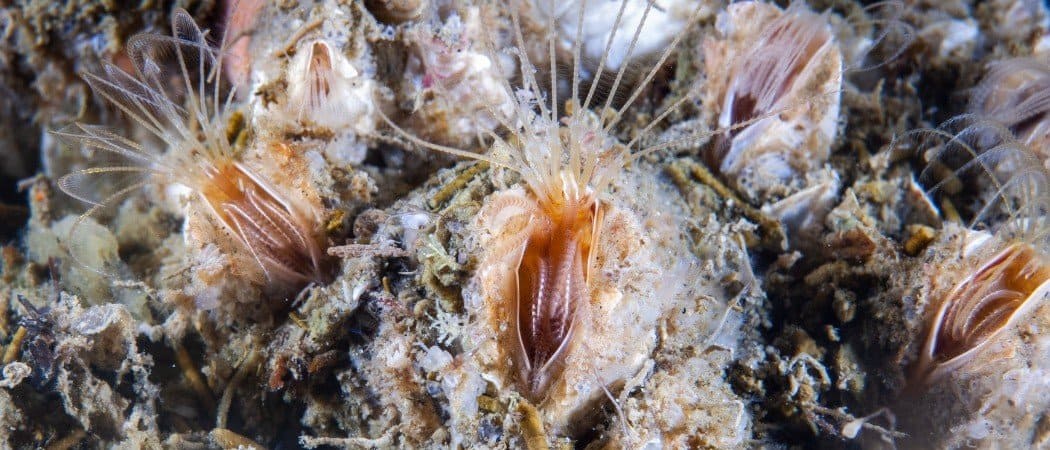
Barnacles are marine organisms that permanently attach themselves to hard surfaces, yet they are not shells or simple sea growths they are arthropods. Specifically, barnacles are crustaceans, meaning they are related to crabs and lobsters. What makes them unusual is their transformation from free-swimming larvae into stationary adults that filter food from the water. This dual nature makes them one of the most intriguing organisms in marine biology. At first glance, barnacles appear lifeless, forming rough clusters on rocks, ships, or even whales. However, beneath their hard outer plates lies a living organism with a complex internal structure and highly specialized feeding system. Their appendages, known as cirri, extend outward to capture microscopic food particles from passing water.
The scientific importance of barnacles has been recognized for centuries. Charles Darwin spent years studying them to better understand variation and evolution. Today, barnacles continue to inform research in ecology, engineering, and environmental science. This article presents a structured and refined exploration of barnacles as arthropods, covering their anatomy, lifecycle, ecological significance, and relevance in both science and human activity.
Classification and Arthropod Characteristics
Barnacles belong to the phylum Arthropoda and the subphylum Crustacea. Like all arthropods, they possess an exoskeleton, segmented body parts, and specialized appendages. However, their adult form differs significantly from typical crustaceans. In early life stages, barnacles display clear arthropod traits such as movement, sensory perception, and molting. As they mature, they undergo a transformation that results in a sessile, or stationary, lifestyle. This shift once led to confusion about their classification.
Evolutionary biologist Richard Dawkins has highlighted how organisms like barnacles demonstrate the flexibility of evolutionary design. Their anatomy evolves dramatically while still maintaining core genetic relationships with other crustaceans. This classification confirms that barnacles are not passive organisms but active participants in the arthropod lineage.
Anatomy and Structural Adaptations
Barnacles are encased in a hard shell composed of calcium carbonate plates. This shell protects them from predators, environmental stress, and desiccation during low tide.
Inside, their body is uniquely oriented. Unlike most animals, barnacles attach their heads directly to the surface, while their feeding appendages extend outward into the water.
| Structure | Description | Function |
|---|---|---|
| Shell Plates | Hard outer covering | Protection |
| Cirri | Feather-like limbs | Filter feeding |
| Cement Glands | Adhesive-producing organs | Permanent attachment |
| Mantle | Soft internal tissue layer | Body enclosure |
One of the most remarkable features is their adhesive. Barnacle glue is incredibly strong and functions effectively underwater, making it a subject of scientific study for industrial and medical applications.
Lifecycle and Development Process
The barnacle lifecycle is a striking example of transformation. It begins with a free-swimming larval stage called the nauplius, which feeds and grows in the water column.
After several developmental stages, the organism becomes a cyprid larva. At this point, it stops feeding and focuses entirely on finding a suitable surface for attachment.
| Stage | Key Characteristics | Duration |
|---|---|---|
| Nauplius | Free-swimming, feeding larva | Several days |
| Cyprid | Surface-seeking, non-feeding stage | Short duration |
| Adult | Fixed, filter-feeding organism | Years |
Once attached, the barnacle undergoes metamorphosis into its adult form. This shift from mobility to permanence is rare and highlights the adaptability of marine arthropods.
Marine scientist Jane Lubchenco emphasizes that such lifecycles allow species to disperse widely while securing stable habitats.
Feeding Behavior and Survival Mechanisms
Barnacles are filter feeders, relying on water currents to supply food. Their cirri move rhythmically, capturing plankton and organic particles suspended in the water. This feeding strategy is energy-efficient and well-suited to their stationary existence. Barnacles adjust their feeding activity based on environmental conditions such as water flow and tide levels.
During low tide, they close their shells tightly to conserve moisture and protect themselves from drying out. This ability to withstand fluctuating conditions allows them to thrive in intertidal zones. Their survival depends on a balance between exposure and protection, demonstrating a finely tuned adaptation to coastal environments.
Ecological Importance in Marine Ecosystems
Barnacles play a vital role in maintaining marine ecosystems. By filtering water, they help regulate nutrient levels and improve water clarity. They also provide habitat and shelter for smaller organisms, contributing to biodiversity. Many species rely on barnacles as a food source, including fish, birds, and invertebrates.
Paleontologist Stephen Jay Gould described organisms like barnacles as ecosystem engineers because they shape their environment in ways that support other life forms. Their presence is often an indicator of environmental health, particularly in coastal ecosystems where conditions can change rapidly.
Interaction with Human Activities
Barnacles have a direct impact on human industries, especially maritime operations. Their tendency to attach to ship hulls leads to a process known as biofouling. Biofouling increases drag on ships, reducing fuel efficiency and raising operational costs. As a result, industries invest heavily in coatings and cleaning technologies to manage barnacle growth.
At the same time, barnacles offer benefits. Their adhesive properties inspire innovations in waterproof glues and surgical materials. Scientists are studying how barnacle cement works to develop new technologies. This dual relationship highlights both the challenges and opportunities barnacles present to human society.
Evolutionary Insights and Scientific Value
Barnacles have long been important in the study of evolution. Charles Darwin’s research on barnacles contributed significantly to his understanding of natural selection and variation. Their ability to adapt structurally while maintaining genetic continuity provides a clear example of evolutionary processes. Barnacles also demonstrate convergent evolution, where unrelated species develop similar features due to environmental pressures. Their shell structure, for instance, resembles that of mollusks despite a completely different evolutionary origin. This illustrates how environmental demands can shape biological design in similar ways across species.
Environmental Challenges and Future Outlook
Barnacles face increasing challenges due to environmental changes. Ocean acidification affects their ability to form shells, while rising temperatures influence their distribution and survival. Changes in ocean currents can disrupt larval dispersal, potentially altering population patterns. Pollution further threatens their feeding and reproductive processes.
Despite these challenges, barnacles are known for their resilience. Their adaptability may help them survive in changing environments, though the long-term effects remain uncertain. Understanding these impacts is essential for predicting changes in marine ecosystems and preserving biodiversity.
Takeaways
- Barnacles are crustacean arthropods with unique biological adaptations.
- They transition from mobile larvae to permanently attached adults.
- Their anatomy includes specialized feeding appendages called cirri.
- They play a crucial role in marine ecosystems and biodiversity.
- Barnacles impact industries through biofouling but inspire innovation.
- Their lifecycle provides insights into evolutionary processes.
- Environmental changes pose challenges but highlight their resilience.
Final Words
Barnacles, though often overlooked, represent one of the most fascinating examples of adaptation in the natural world. Their identity as arthropods connects them to a vast and diverse group of organisms, yet their lifestyle sets them apart in remarkable ways. From their early mobility to their fixed adult existence, barnacles embody the balance between change and stability. They contribute to ecological systems, influence human industries, and provide valuable insights into evolution and material science.
As marine environments continue to evolve, barnacles will remain both indicators and participants in these changes. Their resilience offers hope, but also a reminder of the delicate balance within ocean ecosystems. In understanding barnacles, we uncover a deeper story about life’s ability to adapt, persist, and innovate in even the most challenging conditions.
FAQs
What type of animal is a barnacle?
Barnacles are crustaceans within the arthropod phylum, related to crabs and lobsters.
How do barnacles stick to surfaces?
They secrete a powerful natural adhesive that allows permanent attachment to hard surfaces.
Do barnacles move during their life?
They are mobile as larvae but become permanently fixed as adults.
Why are barnacles important?
They filter water, support biodiversity, and play a key role in marine ecosystems.
What problems do barnacles cause?
They cause biofouling on ships, increasing drag and fuel consumption.
APA References
Darwin, C. (1854). A monograph on the sub-class Cirripedia. Ray Society. https://www.biodiversitylibrary.org
Encyclopaedia Britannica. (2023). Barnacle. https://www.britannica.com/animal/barnacle
National Oceanic and Atmospheric Administration. (2022). What are barnacles? https://oceanservice.noaa.gov/facts/barnacles.html
Ruppert, E. E., Fox, R. S., & Barnes, R. D. (2004). Invertebrate zoology (7th ed.). Brooks/Cole. https://www.cengage.com
University of California Museum of Paleontology. (2020). Introduction to Arthropoda. https://ucmp.berkeley.edu/arthropoda/arthropoda.html